
5 Top Copywriters Share Their AI Philosophy and Favourite Tactics (With Detailed Breakdowns)

Adoption of AI as a copywriting tool is surging.
If you work on marketing or sales materials in any capacity, there’s a good chance you’ve used one of the popular models in the last twenty-four hours.
But what does smart use actually look like?
To build a picture of both the possibilities and limitations of AI, I spoke to five of the world’s most highly respected copywriters: Bob Bly, Kim Krause Schwalme, David Deutsch, Lorrie Morgan, and Anita Siek. They all have a proven track record of client results and have done lots of AI testing.
How Are Top Copywriters Using AI? A Quick Overview
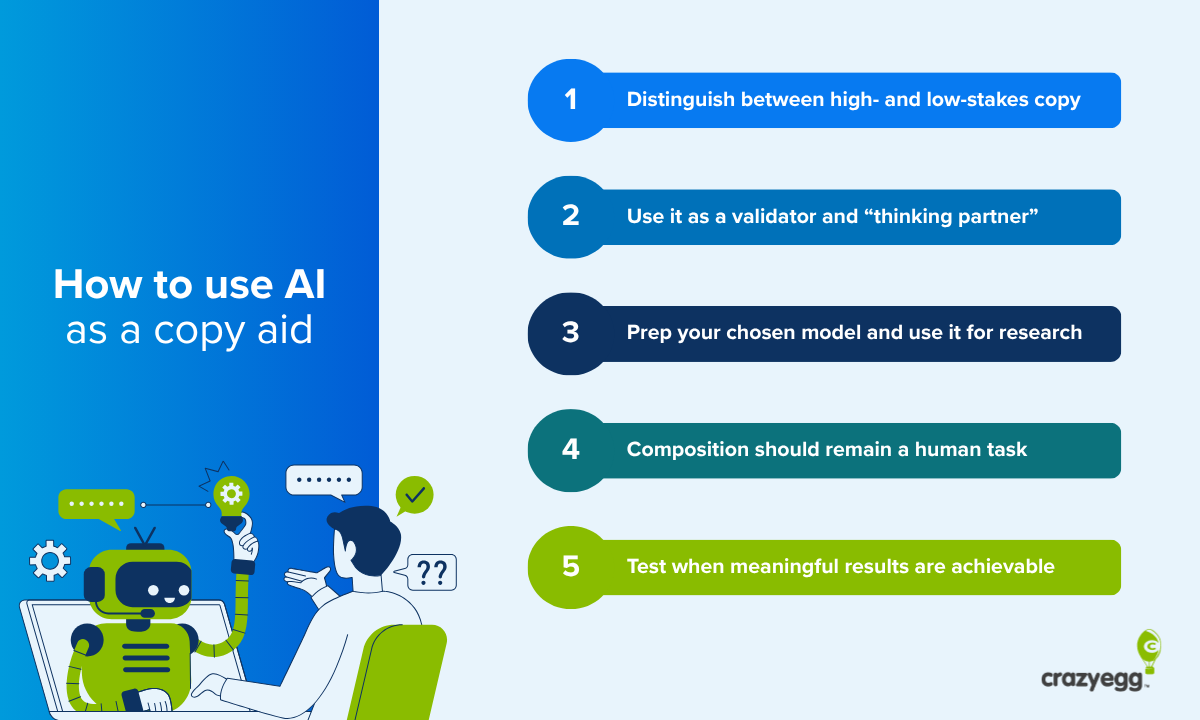
A series of key themes, examples, and philosophies kept reappearing as I conducted my interviews. Before we hear from the experts, here are five rules of thumb for using AI to help you create copy.
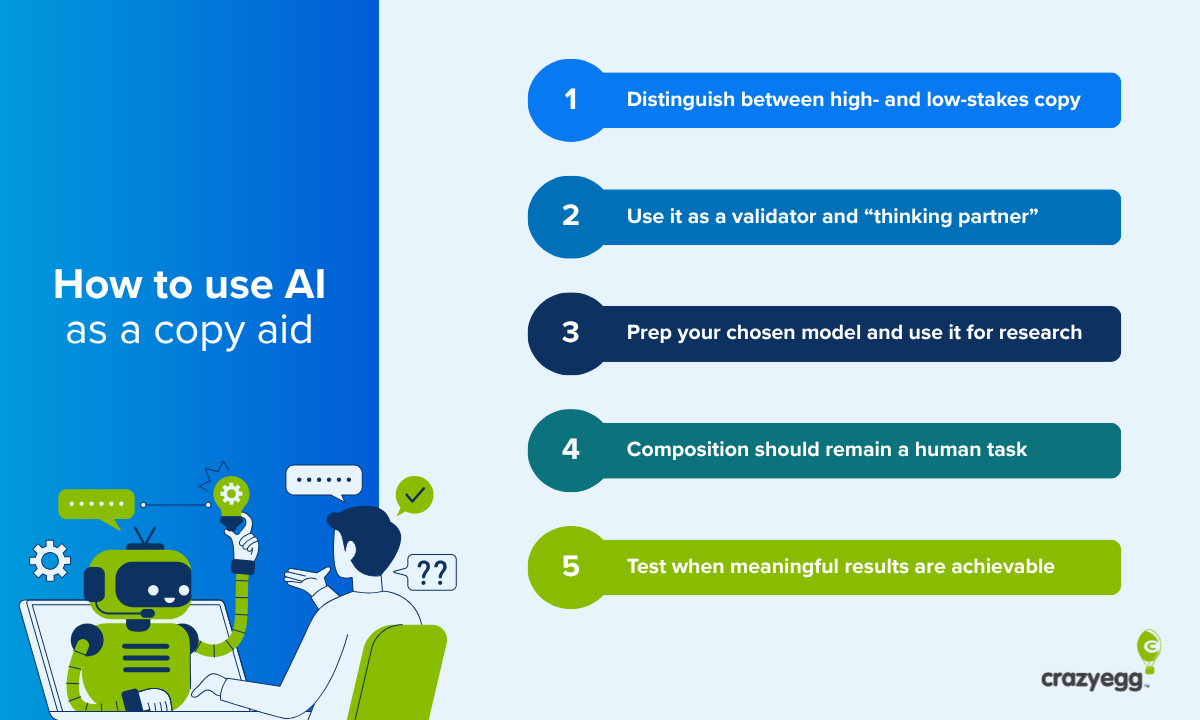
1. Distinguish between high and low-stakes copy
Not all copy serves the same purpose. Indeed, not all copy needs to be good. There is a significant difference between a direct mail big-idea brochure, for example, and a flyer for a local cafe.
If your copy is meaningfully tied to revenue, deep human input during writing from what Bob Bly calls an “A-list” copywriter is essential. This is where you need to be extra careful about AI use, even if you’re providing extensive context.
If your copy is tangential, or if you can test multiple variations and generate statistically meaningful results, then AI can take a more significant role in composition.
2. Use AI as a validator and “thinking partner”
Everybody that I spoke to used AI to assist with idea generation in some capacity. The essential point, and this was emphasized numerous times, is to actually use it as a partner, not a replacement.
The following research tasks were given as examples:
- Validating embryonic “big ideas” to see if there is enough “meat on the legs”
- Generation of important copy elements (like headlines and CTAs) for variant ideas
- Outline generation at the beginning of projects
- Brainstorming of additional topic angles once an outline is completed
- “Self-criticism” where AI is asked to critique its own work
3. Prep your chosen model and use it for research
Customer research was another consistent use case, with context prep as the initial phase. The idea is to provide a model with enough pre-existing copy models and principles that are known to generate results, and then to monitor the outputs and refine your guidance.
AI can excel at the following tasks with appropriate guidance:
- Avatar research in which you ask an AI chatbot questions and have it simulate your customers
- Reddit scraping for voice of customer (VOC) research
- Use as a “gap finder” to identify potential holes in research reports
- Brief creation that combines customer research with established copy principles
Your ultimate aim should be to create a repeatable system based on your writing framework. Pre-existing frameworks are important, but real examples, unique strategic context, and ongoing testing and iteration are what make the real difference.
Anita Siek put it perfectly: “The businesses that are winning in this era know how to critically and strategically think and teach their AI tools to follow that strategy.”
4. Composition should remain a human task
All of the copywriters were unanimous on the need for human input during composition. Kim Krause Schwalme pointed to the “dry” and “almost clinical” nature of AI-written copy. Lorrie Morgan said she wants to ”hear your voice, not C-3PO’s.”
Human copy is fast becoming a competitive advantage. AI simply cannot replicate human stories and is unable to mirror the nuances of a well-formed voice. Algorithm aversion, in which people are turned off merely by the belief that something is AI, is also an ever-present specter.
5. Run tests if meaningful results are achievable
When I spoke to David Deutsch, he had just finished reworking a letter that would be sent on behalf of a CEO. It had been a fully human process with numerous revisions. Yet he also spoke about another client for whom he was running dozens of tests, many of which were AI variants.
If you can meaningfully test variations, then AI use becomes much more feasible. One cardinal rule of the copywriting world is that it’s impossible to know exactly whether one ad will outperform another. And surprises happen.
Anyway, enough of me. Let’s hear what five greats of the copywriting world have to say about good ol’ artificial intelligence.
Bob Bly: AI Is an Inferior Writer but Can Help Validate Ideas
Bob Bly is one of the world’s preeminent copywriters. He was named Copywriter of the Year by the American Writers & Artists Institute in 2008 and is the author of the bestselling book The Copywriting Handbook. In addition to his copywriting practice, he also works as a mentor and consultant.
He continues to follow the rise of AI closely and recently published AI Apocalypse, which details how AI has been portrayed in literature, art, and film.
General AI Outlook: Don’t Let AI Do the Writing if Your Copy Matters
When I spoke to Bob, he made it clear that he’s broadly against the use of AI as a writing tool: “There are many nuances to the question of who should use AI and how it should be used. Overall, it is inferior to a human at this time. It may not be in ten years, it may not be in three years, but right now, it’s inferior.”
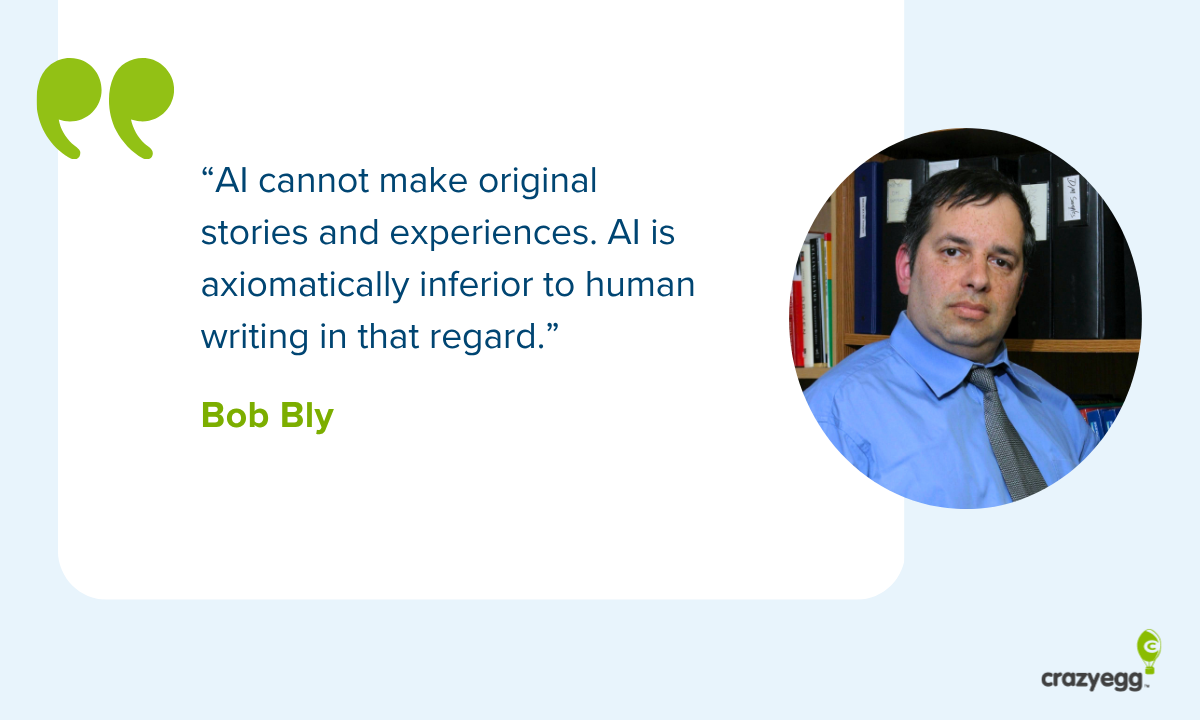
Bob’s view is informed by three factors: his own use of popular AI tools, third-party studies, and his work as a consultant for which he regularly reviews the work of other copywriters. He pointed to storytelling as the biggest shortcoming: “AI cannot make original stories and experiences. AI can only regurgitate other stories that are not its own, and storytelling is such an important part of so many different types of writing, including copywriting. AI is axiomatically inferior to human writing in that regard.”
At the core of the “nuance” required for using AI effectively is the ability to tell when high-quality or “A-list” copy is critical and when it’s not. “For a lot of businesses, copy is not critical. It’s not that important. So it makes no sense for them to spend $1,000 on a top copywriter when they can produce a serviceable ad either on their own or via AI.”
The risk, however, comes from opting for subpar tools when copy has a direct impact on revenue. Direct response copy, the type that Bob works most closely with, is one of the best examples. “Copy that sells directly from the screen or the page—that’s the most difficult copy to write. It’s the most measurable, and results are everything. In that case, AI generally underperforms a human writer.”
Favourite Use Case: Using AI to Vet Big Ideas
Despite his broadly anti-AI stance, Bob explained one use case where he sometimes uses tools like ChatGPT to see if there’s enough “meat on the legs” of ideas for “big idea packages” before running with them.
These longform promotions, which are common in health and finance, sometimes run into dozens of pages or 30-minute video sales letters (VSLs). They’re built around one central premise.
He told me how he vetted an idea for a financial package for a stock market newsletter: “If we go back six or seven months, I had an idea for a financial package around what happens if the Strait of Hormuz closes and what that’s going to do to the energy industry, the oil and gas supply, the stock market, and the economy. I didn’t know the answers to those questions or if there was enough meat there, so I said to ChatGPT, ‘Tell me nine things that will happen if the Strait of Hormuz closes.’ And it gave me the ideas to write a package. It even gave me specific stocks and categories of stocks, like oil field equipment, that I wouldn’t have thought of.”
Bob stressed that he doesn’t use AI to generate the core idea. Rather, he uses it as a validating tool for an embryonic idea, one that will sit at the core of a package, when its depth and substance are uncertain.
Kim Krause Schwalm: AI Is a Useful Brainstorming and Research Tool
Kim Krause Schwalm is widely regarded as one of the best copywriters in America. Over a career spanning decades, she built a reputation for outperforming controls (best-performing benchmark ads against which new versions are tested) that were often considered unbeatable.
She has worked with many marketing greats, including Jay Abrahams and Denis Waitley, and now focuses primarily on mentorship and teaching via her website and newsletter, where she regularly writes about AI.
General AI Outlook: A Useful Tool for a Range of Copywriting Tasks
Kim sees AI as a tool. A serious tool, but a tool nonetheless. One that requires human oversight and input and that shouldn’t act as a full workflow replacement.
She outlined several examples, all of which fell into two broad categories—idea generation and automation of time-consuming “grunt work.”
For ideas, Kim uses AI in the early stage of writing. “I’ll sometimes use it to generate headline ideas and polish and refine from there,” she told me, “and as a collaborative tool for brainstorming angles. For avatar and problem research, especially when writing for a new niche or audience, AI can help with preliminary insights. Sometimes it can help create a story based on an avatar profile.”
On the automation front, Kim typically uses it to “generate summaries and sales copy based on transcripts of recordings” from sources like courses. She also mentioned non-writing examples: “It’s not related to writing, but if I want to analyze sales or other financial data for my business, AI can save a ton of grunt work.”
Favourite Use Case: Prospect Avatar Creation
One of Kim’s favorite AI use cases is as an aid for developing and refining profile prospects. “I like doing something called the Prism exercise,” she said, “which is a series of questions I use for creating a profile of a target prospect or avatar. It helps paint a clear picture of the avatar’s biggest pain points, desires, frustrations, etc.”
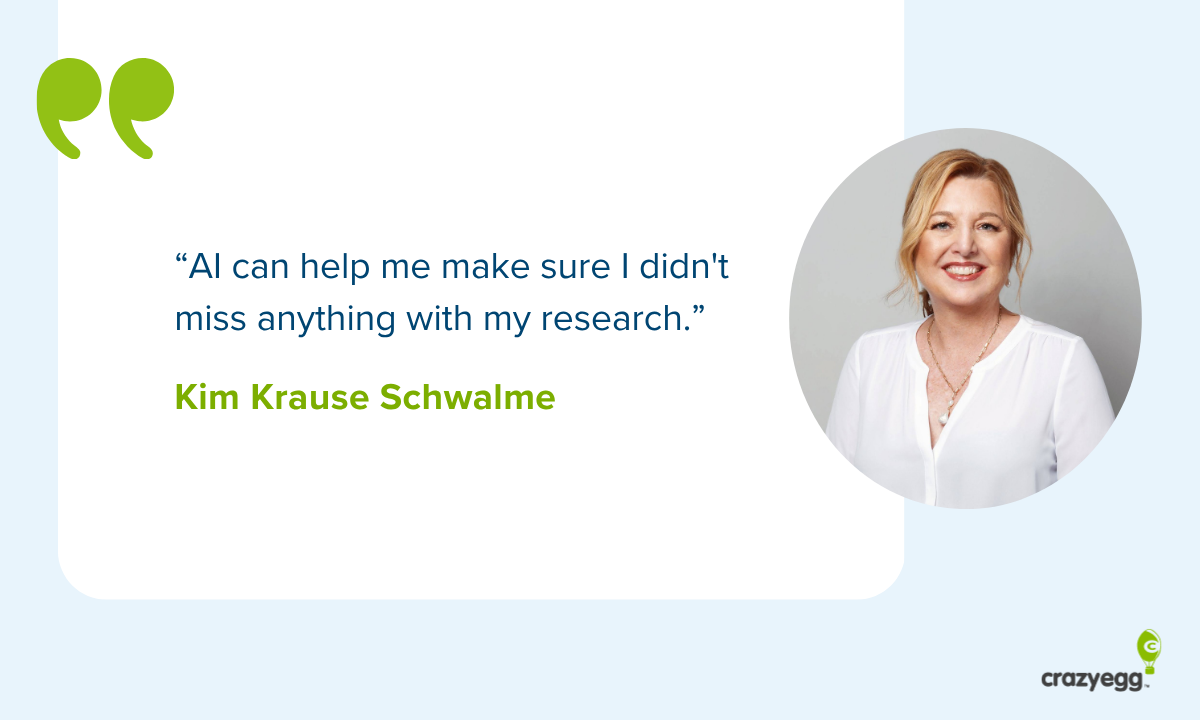
“I’ve always done it manually, based on research I’ve pulled from surveys, forums, articles, and other avatar research. Doing it that way allows me to capture the actual words and language the prospect uses and often produces more emotionally hard-hitting insights I can directly use in my copy. But I also like to use AI with the same questions as prompts to see what outputs I get. It helps me make sure I didn’t miss an
Kim is quick to point out, however, that AI shouldn’t replace this stage of research entirely: “It’s not a substitute for also doing it manually, since the ‘copy’ it produces is often very dry, devoid of emotion, and almost clinical.”
David Deutsch: There Are Good AI Use Cases But Protect Your Thinking Skills
After starting his career at Ogilvy & Mather, David Deutsch left Madison Avenue to become a self-described “born-again direct response fundamentalist.” He has since generated over $1 billion in sales through digital and direct mail copy.
He writes regularly (including about AI) on his Substack, Speaking of Writing, and runs a popular copywriting newsletter.
General AI Outlook: Human Reasoning and Personality is a Competitive Advantage
David takes a nuanced view of AI as a copywriting aid. “It’s a tool,” he tells me, “and like any tool, it needs to be used very carefully, maybe more so than most tools.”
His general position is that AI is useful as a critical editor and thinking partner: “My stance, and I would advocate this for any writer, is not to use it quite so generatively, not to use it to generate copy, but use it to use it almost as a foil to bounce ideas off of and point out parts that might be boring or awkward or provide ideas for what could make it more interesting.”
He also made the point that this is true for “highly competitive” markets, especially when there’s a large amount of AI slop. “If you really want to compete in a competitive market, your copy needs to be above what’s out there in order to get attention. Everyone’s using AI to generate copy. So it presents an opportunity for your copy to have a voice, to have a personality, to have a real person behind it.”
He was also keen to emphasize that what makes this proactive approach so important is the mental cost of over-reliance on AI: “There’s also a general downward trend in people’s cognition,” he said. “I think people are over-relying on AI and losing the ability to think, and that not only makes the ultimate output less good because you’re not participating in it, but it also weakens your muscles. So I think it’s really important to always start off by thinking. Don’t just ask AI for ideas. Say, ‘Here are my ideas. I want you to come up with, critique these and come up with more ideas.”
Favourite Use Case: Automated Research for High-Volume Copy
While David advocates a human approach for copy, especially for high-impact industries like finance and weight loss, he does accept that there’s nuance. In certain cases, where volume is important and it’s possible to test, he says that AI can take over more of the process.
“There are some clients I work with that, because of the nature of their business, need to use AI to generate their copy,” he told me. “For those clients, it’s a different sort of problem. Then we ask, ‘How do we give AI the best input that we can?’”
His process loosely falls into four steps: set up a foundational system, run lots of research, distill that research into specific briefs, and test, test, test.
“We set up a very definite system where we have frameworks for the AI to base the copy on. Whether that’s Eugene Schwartz’s stages of awareness, for example, or AIDA, or jobs to be done. We then use AI to go out and analyze the competition and see what people are really concerned about deep down, such as by analyzing Reddit posts, and how they are expressing these concerns.”
Before prompting the beast, all of this deep research is analyzed and converted into a brief. “There’s a step in between of boiling it down. You want to be able to give an AI tool a brief and say this is what I need: ‘I need an email, here’s the brief,’ or, ‘I need a sales letter, here’s the brief.’ And the brief has everything. All of the research boiled down in a way that AI can read it easily and use it.”
Finally, where possible, David tests variants against each other: “AI can be a tremendous asset for testing because it can generate a lot of tests. In these cases, I don’t care if it sounds like AI if it works. We can test it and see. So I’d rather be able to test 100 things than craft one thing that sounds great and not AI. I’d rather take 100 shots at the target.”
Lorrie Morgan: Writers Still Need to Be Willing to Get Their Hands Dirty
Lorrie Morgan is yet another doyen of the copywriting world. She was mentored by the likes of Gary Halbert, John Carlton, and Dan Kennedy and has regularly been included in lists of the all-time greatest copywriters.
Her copywriting services are available through her website, Red Hot Copy, and she also publishes regularly on her Substack Red Hot Inkslinger.
General AI Outlook: Don’t Sacrifice the Human Element
Lorrie experiments extensively with AI. While she acknowledges that it can be useful for certain low-level tasks, her main concern is the inability of AI to communicate real experience. She also spoke about the ever-present specter of AI aversion.
“When AI first came out,” Lorrie told me. “I was working as a copy chief. It was terrifying because my copywriters were being replaced right, left, and center. About six months later, they were all hired back. It turns out that AI wrote cold, soulless copy that turned people off even back then.
Lorrie said that the sameness of the outputs of AI tools is one of her big problems. “I’ve played around with the different models from the start. Early on, you could train them to write in your style. Sure, you’d need to make a few edits, but it wasn’t egregious. Then AI became homogenized. No matter what you ask for or how much you try to wrangle it, it goes back to the same patterns. This is dangerous. Writers are popping their prompts into AI and copy-pasting the output into posts because it ‘sounds’ smart. It doesn’t. Personally, when I smell an AI post or article, I’m out. I want to know the way you think, not C-3PO’s interpretation.
She also argued that the principle even applies to businesses for which copy might not be make-or-break critical: “I can appreciate the speed AI works at. A lot of businesses think it’s going to save them so much time. But it’s seductive to think you can save hours by using AI instead of writing it yourself. If your business insists on using AI, have a defined guide to spot AI tells and let a human make it sound more human before you release it to the world.”
Favourite Use Case: Brainstorming and Outlines
Lorrie didn’t make the case that AI has no place in a copywriter’s toolkit. She has no issues with it as an aid for brainstorming ideas and cleaning up drafts.
“I use AI more for brainstorming ideas and to shape outlines. For example, I just created an AI ‘Rescue Kit’ on how to edit AI so it sounds human. And I used Claude to help tell on its ilk. How meta is that? Some of the ideas I hadn’t even thought of were good and some weren’t.”
One issue that the AI flagged was its own relentless positivity: “AI never has a bad day. It never gets frustrated, loses a client, doubts itself, or says the wrong thing. That frictionless optimism is exactly what makes it feel inhuman. Readers trust writers who’ve actually been through something.”
She finished with some cautionary advice: “Don’t let AI hijack your style. You can even let it write a first draft if you want, but you better be ready to get your hands dirty and clean that crap up.”
Anita Siek: AI Combined With Behavioral Psychology Is the Winning Mix
Anita Siek is a copywriter, speaker, podcaster, and trainer. She advocates a unique, multi-pronged approach to AI copywriting, which incorporates her “human-centered” philosophy and her expertise in behavioral psychology.
She runs Wordfetti, a respected copywriting house, and offers a range of services and training packages through her website.
General AI Outlook: AI Is Powerful but it Needs Deep Context
Anita is positive about AI. She believes businesses need to combine two things: AI tool know-how and a deep understanding of human psychology.
“I think businesses that are winning in this era aren’t just the ones using AI,” she told me. “They’re the ones who know how to critically and strategically think and teach their AI tools to follow that strategy. And the same goes for AI as a copywriting tool.”
“AI is an amplifier. It’s only as good as the input you write. Crappy input? Crappy output. What makes AI use different is the thinking behind it, the clarity in the brief it gets, and any unique IP you feed it. When you lean on AI to do your thinking, you’re ultimately saying AI is the expert and you’re the intern.”
When I asked Anita if AI copy can be as good as human copy, she said it depends on what is classed as good in the first place. “Good copy to me is copy that actually gets people to buy. In my eyes, that requires an understanding of human behavior, psychology, lived context, emotional intelligence and a finger on the pulse of all the moving feelings, desires, and fears for our audience. AI can’t feel a customer’s resistance in real time or understand the wobbliness in someone’s voice before a buying decision.”
For Anita, successful use ultimately comes down to the strategy behind the use of the AI tools: “I feel like businesses using AI well are those who are still deeply connected to human psychology. They’ve got their strategy nailed and use AI to scale faster.”
Favourite Use Case: Teaching AI a Repeatable System
Anita’s favorite use case involves teaching AI a framework or repeatable system that mirrors a process that is already working well.
“Think of something you do repeatedly like writing a proposal or creating a content plan,” she said. “Map out the way you do it or have AI analyze it and identify the patterns for you. Get it to learn the way you do something, either by giving it raw examples, a Loom video, or a transcript. Then have it document the process so it can do more of it for you, faster and better.
“At Wordfetti, for example, we’ve created FETTIBot, a human-trained AI bot. It’s trained on over nine years of our IP, which covers copywriting, content, and marketing frameworks and strategies. It knows how to ask the right questions to best support users with their copy, messaging, and content. It can write high-converting sales pages and carousels. It also critiques copy to make it better.”
Wrapping Up: AI Tools Are Powerful but Human Input Still (Really) Matters
It’s become a cliché to say that AI “isn’t going to replace human writers; it’s going to replace writers who don’t know how to use AI.” I’ve seen this sentiment made fun of more than once on LinkedIn.
But as with so many cliches, it comes from truth. Spend any amount of time on a popular job board, and you’ll see marketing leaders repeatedly asking for AI fluency.
The main insight that became apparent to me while interviewing for this article is that AI has well-demarcated abilities. It can brainstorm and can critique. It can be useful for generating variations within a rigorous testing structure. And for businesses where copy isn’t critical, there’s little to lose.
But it can’t replicate experience and unique style. And the consensus, at least among the experts I spoke to, is that these things are vital for copy that actually drives serious revenue.
In my view, the future is hybrid. I think that while AI systems will continue to improve, there will always be a need for precise human inputs at various stages of drafting and editing.

