Trust is the True Moat: What AI is Actually Changing for SaaS

We don’t agree with the simplistic formulation of “AI is eating SaaS,” and we’ve consistently written about that. SaaS companies get paid to solve business problems, and SaaS companies – or at least the healthiest and most adaptable among them – will incorporate AI into their solutions and continue to get paid to solve business problems.

“AI is Scary and will Eat You!”
Instead of AI eating SaaS like a leopard eating a gazelle, however, we believe SaaS will “eat” AI somewhat more like one amoeba eats another. SaaS and AI together then morph into some kind of hybrid software-AI solution provider, just like traditional software “ate” cloud computing and thereby morphed into SaaS. (We’ve hinted at this with our reformulation of the acronym as “Subscription AI and Software.”)
But along the way there are some very interesting new patterns we’re seeing (and some we’re not seeing).
Pattern #1: The most interesting thing we’re not seeing is losing customers to vibe-coded solutions. Yes, we’ve heard of borrowers losing renewals or RFPs to enterprises building software internally, but these stories are still so rare that we don’t think it’s meaningfully different from pre-AI “build vs. buy” tension.
Sales cycles, including renewal cycles, are lengthened and plagued with uncertainty as enterprise buyers ask, “what if AI can just do this for us in six months / what if we can just ‘vibe code’ this.” But, the conclusion is almost always that the enterprise sticks to their knitting, and pays money to a solution provider (SaaS company) to solve the problem. The exceptions have largely been IT-for-IT plays or very large, IT-sophisticated enterprise customers (think: money center banks) who have a long track record of internally built software.
But this doesn’t mean that every SaaS vendor is untouched; read on for why.
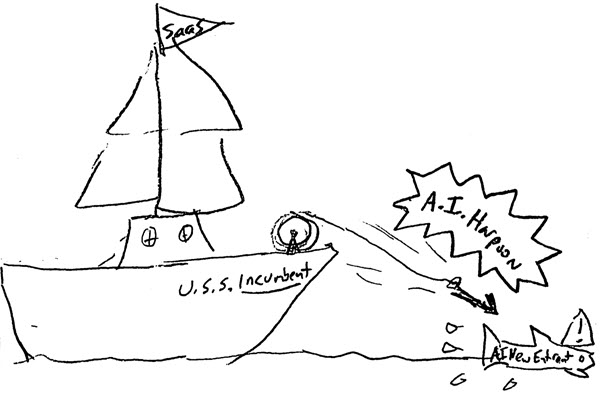
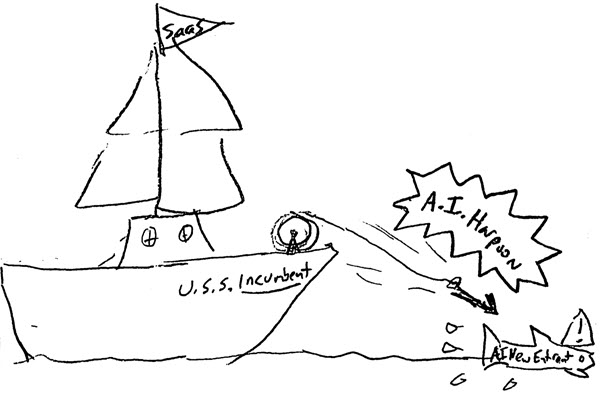
Pattern #2: The most interesting pattern we have detected in the past two months looks like this: An incumbent vertical SaaS vendor goes up for renewal with an enterprise customer. During their needs discovery, the vendor learns that the customer is considering purchasing a new, usually horizontal, SaaS solution to sit “alongside” the vendor, to handle some adjacent problem.
What happens in this case is that the verticalized incumbent vibe-codes the horizontal solution for the client. This means a bigger share-of-wallet and deeper relationship for the vertical incumbent, and a shrinkage of TAM for the horizontal player.
We might not be so bold as to claim this is a pattern, except that we’ve seen this same play three times in our own portfolio in 1Q 2026.
While the sample size here is admittedly small, we think the key areas of advantage for the winners here are being 1) vertical, 2) incumbent, 3) highly trusted through experience, 4) the point of interface / usage, and ideally also 5) the system of record. The key areas of danger/disadvantage for the displaced are being 1) horizontal, 2) new entrant or at-risk for renewal, 3) back-end “pipes,” “glue,” or “middleware” less seen by users. Some of the displaced horizontal solutions would claim they are “systems of record,” but, you can’t be a system of record if they don’t choose to start accumulating their records in your system.
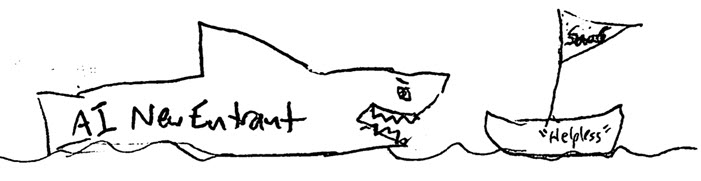
This Pattern #2 might be seen as a special case of the general observation that AI and speed of new development is accessible not only to new entrants but also to incumbents. Much of the “SaaSpocalypse” fear and doubt was premised on the idea that new, AI-powered companies would be coming to attack the weak SaaS incumbents, like an angry megalodon tearing into a helpless canoe.
It’s entirely true, of course, that new entrants can use AI. But, so can incumbents, a point seemingly lost on the hype-meisters and fear-mongers. We think that in many cases, the real action looks quite different, and that the advantage of incumbency – when indeed the incumbent has earned the trust of the customers – is actually multiplied by AI adoption.